Autism, ADHD and Sibling Relationships: How to Build Understanding and Stronger Family Bonds
When one child in a family has Autism, ADHD, or both, siblings often notice the differences long before they have the words to explain them. They may see meltdowns, routines, sensory needs, impulsive behaviour, extra appointments, or different rules. Without clear guidance, they can feel confused, left out, protective, annoyed, guilty, or worried.
Siblings do not need a clinical textbook. They need honest, age-appropriate explanations, space to ask questions, and everyday ways to connect. With the right support, siblings can become more understanding without feeling pressured to become carers or “perfect” brothers and sisters.
This article is for general information only and is not a substitute for personalised medical, psychological, or educational advice. Families who need tailored guidance can speak with qualified professionals, including the team at Clinic Autism London, for support around Autism, ADHD, family communication, and practical next steps.

Why siblings need clear education about Autism and ADHD
Children often create their own explanations when adults do not give them one. A sibling might think, “They get away with everything,” or “Mum and Dad love them more,” or “If I was louder, I would get more attention too.” These thoughts are understandable, but they can lead to resentment, anxiety, or distance.
Education helps siblings understand that Autism and ADHD affect how a person experiences the world, communicates, manages attention, handles emotions, and responds to change.
A simple explanation might sound like this:
“Your brother’s brain notices and reacts to things differently. Loud sounds can feel painful to him, and changes can feel very hard. He is not trying to upset anyone. We are helping him learn what to do when things feel too much.”
For ADHD, parents might say:
“Your sister’s brain finds it hard to pause and think before acting. She may interrupt or move around a lot, even when she is trying not to. We are helping her learn ways to manage that.”
These explanations reduce blame. They also show that support does not mean ignoring hurtful behaviour. A child can understand both truths at once: their sibling may need help, and everyone in the family deserves kindness and safety.
Keep explanations age-appropriate
A four-year-old may only need to know that their sibling gets overwhelmed by noise and needs quiet time. A ten-year-old may be ready to learn about sensory processing, executive functioning, and emotional regulation. A teenager may want a more detailed conversation about diagnosis, school support, medication, therapy, masking, or social difficulties.
Parents can use everyday moments to teach gently. For example, after a noisy supermarket trip, a parent might say:
“Did you notice how the lights and sounds were difficult for Sam? That is why we left early. Next time, we can bring headphones and make a shorter list.”
This helps siblings connect behaviour with need, rather than seeing only the disruption.
Avoid making one child the lesson
Education should never turn the autistic child or child with ADHD into a case study. Talk respectfully. Protect privacy. Ask older children what they are comfortable sharing.
Try to avoid comments such as:
“You know what he’s like.”
“She can’t help it, so just ignore it.”
“You have to be the sensible one.”
These phrases can place too much responsibility on siblings. A better message is:
“We are all learning how to support each other.”
“You can be upset and still be kind.”
“It is the adults’ job to keep things fair and safe.”
Practical ways families can build empathy and communication
Empathy grows through repeated small experiences, not one big conversation. The goal is not to make siblings agree all the time. The goal is to help children understand each other’s needs and communicate with less blame.
Name needs instead of labelling behaviour
Families can help siblings shift from “annoying” to “overwhelmed”, from “rude” to “struggling to switch tasks”, and from “bossy” to “needing predictability”.
This does not excuse every action. It gives the family a more useful starting point.
For example:
Instead of “Stop being difficult.”
Try “The change of plan feels hard. Let’s use the visual schedule and choose what happens next.”
Instead of “Why are you always interrupting?”
Try “Your brain has lots of thoughts coming quickly. Put your hand on my arm, and I will know you have something to say.”
Siblings can learn these phrases too, but parents should model them first. Children copy what they hear most often.
Create family rules that apply to everyone
Fair does not always mean identical. One child may need headphones at dinner, another may need a warning before a sibling enters their room, and another may need quiet homework time away from noise.
It helps to create simple family rules that everyone can understand:
Bodies are safe No hitting, pushing, biting, or blocking someone’s way.
Words should not hurt on purpose No name-calling, mocking, or using a diagnosis as an insult.
Everyone can ask for space A break is allowed before feelings get too big.
Adults help solve hard moments Children do not have to manage conflict alone.
These rules make the home feel more predictable. They also reassure siblings that support for Autism or ADHD does not mean their feelings are ignored.
Teach scripts for tricky moments
Children often want to communicate well, but they do not know what to say when emotions rise. Short scripts can help.
Useful sibling scripts include:
“I need a break.”
“Please stop. That is too loud for me.”
“Can we take turns?”
“I want to play, but not that way.”
“I am upset. I need an adult.”
Parents can practise these when everyone is calm. Role play may feel awkward at first, but it can make real-life conflict easier to manage.
Make repair part of family life
Every family has difficult moments. A meltdown, argument, or impulsive action can leave siblings feeling hurt or frightened. Repair helps children learn that relationships can recover.
Repair does not need to be forced. Some children find spoken apologies hard or confusing. Other repair options include:
Drawing a picture
Helping rebuild a game
Giving space and trying again later
Using a feelings card
Writing a short note
Offering a preferred toy or activity
The key is to focus on reconnection, not shame.
Activities that help siblings bond and understand each other
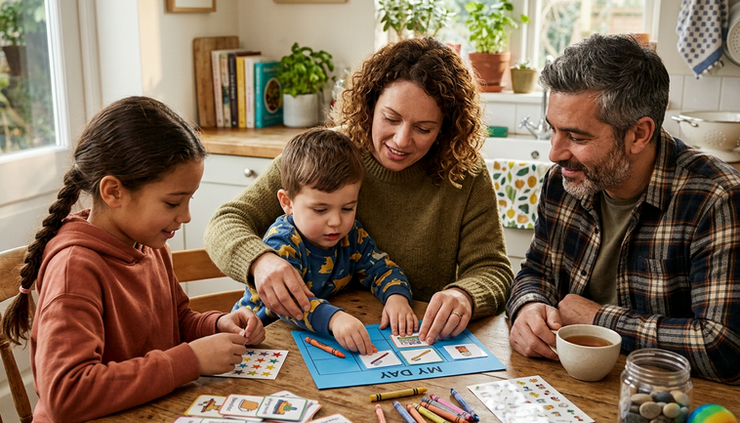
Shared activities work best when they reduce competition and allow different ways to join in. A child with ADHD may need movement. An autistic child may prefer structure or a special interest. A sibling may need reassurance that the activity will not always be taken over.
Choose activities with clear starts and endings, flexible roles, and adult support nearby.
Build around shared interests
Special interests can be a bridge. If one child loves trains, animals, gaming, space, maps, music, or dinosaurs, siblings can join in without needing to lead.
Ideas include:
Making a quiz together about a favourite topic
Building a themed Lego or block scene
Creating a family “museum” on the dining table
Watching a short documentary together
Drawing characters, routes, planets, or animals
Taking turns choosing facts to share
Parents can help by setting time limits and turn-taking rules. For example, “Sam chooses the first dinosaur, then Maya chooses the next one.”
Try parallel play for lower-pressure connection
Siblings do not always need to interact constantly to bond. Parallel play can feel safer, especially when social communication is tiring.
Parallel activities include:
Drawing side by side
Reading in the same room
Playing with separate sensory trays
Building separate models with the same materials
Listening to an audiobook while colouring
Doing puzzles at the table together
This kind of connection can be especially helpful after school, when many children feel tired from managing noise, rules, transitions, and social demands.
Use movement to support regulation
For children with ADHD, movement can help attention and emotional regulation. Many autistic children also benefit from movement, though preferences vary.
Family-friendly movement activities include:
Garden obstacle courses
Trampoline turns with a timer
Animal walks along the hallway
Dance breaks with agreed volume
Scooter or bike time
Nature walks with a scavenger list
Heavy-work tasks, such as carrying cushions or pushing a laundry basket
Parents should be clear about safety and endings. A visual timer can help everyone see when the activity will change.
Create calm rituals
Not every bonding activity needs energy. Calm rituals give siblings predictable ways to reconnect.
Try:
A bedtime story where each child chooses one page
Friday film night with planned snacks and seating
A weekend pancake routine
A shared playlist for quiet afternoons
A family gratitude jar
Five-minute “show me something you like” time
Small rituals matter because they repeat. Repetition builds trust.
Plan sibling-only time too
Siblings of children with Autism or ADHD may sometimes feel that family life revolves around appointments, behaviour support, or avoiding triggers. They need time where their interests come first.
This does not need to be expensive. Ten minutes of full attention can help:
A walk to the shop
Reading together
A board game
Baking
A chat before bed
Watching their chosen programme
Parents can name this clearly: “This is your time with me.” That simple sentence can mean a lot.
How parents can guide conversations about Autism and ADHD
Children often ask direct questions. “Why does he scream?” “Why does she never listen?” “Do I have ADHD too?” “Will he always be like this?” These questions can feel painful, but they are also openings for trust.
Answer honestly without overloading
A calm, short answer is usually better than a long lecture.
If a child asks, “Why does he have meltdowns?” a parent might say:
“His brain and body can get overloaded. When that happens, he may cry, shout, or run away. We are helping him notice the signs earlier. You can help by giving him space and calling an adult.”
If a child asks, “Why does she get more help than me?” try:
“She gets help with things that are hard for her. You also deserve help when something is hard for you. Let’s talk about what you need.”
This answer validates the sibling without creating competition.
Make room for mixed feelings
Siblings may love their brother or sister and still feel angry, embarrassed, jealous, or tired. Mixed feelings are normal. Parents can make those feelings safe to share.
Helpful phrases include:
“You are allowed to feel upset.”
“I am glad you told me.”
“Loving someone does not mean every moment is easy.”
“You are not in trouble for having that feeling.”
“Let’s think about what would help next time.”
Avoid rushing to correct feelings. If a sibling says, “I hate when he ruins games,” the deeper message may be, “I feel disappointed and powerless.” Start there.
Hold family check-ins
A short weekly check-in can prevent resentment from building. Keep it simple and predictable.
Each person can answer:
What went well this week?
What felt hard?
What helped?
What should we try next week?
Some children may prefer drawing, pointing to emotion cards, or using a thumbs-up, sideways, or thumbs-down system. Speech is not the only valid way to communicate.
Protect siblings from adult responsibilities
Siblings can learn kindness and patience, but they should not become unpaid therapists, behaviour managers, or constant protectors. Parents need to make this clear through words and actions.
A healthy message sounds like:
“You can help by being kind and calling an adult when needed. You do not have to fix the problem. That is our job.”
This boundary helps all children. It lets siblings enjoy their relationship without carrying adult pressure.
Work with schools and wider family
Siblings may need support beyond the home. A child might worry about a brother’s behaviour in public, feel protective at school, or hear unkind comments from peers or relatives.
Parents can speak with teachers, pastoral staff, or the school SENCO if sibling stress affects attendance, mood, sleep, or learning. Wider family members may also need education. Grandparents, cousins, and family friends can support better when they understand the child’s needs and the family’s approach.
When families need extra support
Some family challenges need more than good intentions. Support can help when siblings feel persistently anxious, conflict becomes frequent, routines feel unmanageable, or parents feel unsure how to explain Autism and ADHD in a way that fits each child’s age and personality.
Clinic Autism London can be a helpful resource for families seeking guidance, assessment pathways, parent support, and practical strategies. A specialist perspective can help parents understand behaviour, support communication, and create home routines that work for the whole family.
Professional support may be useful for:
Explaining Autism or ADHD to siblings in a sensitive way
Understanding sensory needs and emotional regulation
Building visual supports and routines
Managing meltdowns, impulsivity, or conflict
Supporting parents after a diagnosis
Helping families communicate with schools
Recognising when siblings need their own emotional support
The aim is not to create a perfect household. No family has that. The aim is to build a home where each child feels understood, protected, and valued.
A supportive family culture grows one conversation at a time
Helping siblings understand Autism and ADHD starts with clear education, but it grows through daily life. It grows when parents explain differences without blame. It grows when siblings learn practical scripts, share low-pressure activities, and see adults repair after hard moments. It grows when every child has space to be heard.
Families do not need to solve everything at once. Start with one conversation, one shared activity, or one new routine. Over time, these small steps can turn confusion into understanding and tension into more moments of connection.
Clinic Autism London offers support and guidance for families who want help making sense of Autism, ADHD, and family life. With the right information and compassionate support, siblings can learn not only what makes their brother or sister different, but how to build a stronger relationship with them.