Supporting Neurodivergent Students in the Classroom Inclusive Strategies for Teachers
A student who refuses to write may have brilliant ideas but weak fine motor control. A child who calls out may be trying to hold a thought before it disappears. Another who looks away while listening may be concentrating better than if eye contact were required.
Neurodivergent learners are often misunderstood when classrooms are designed around one “typical” way to pay attention, process language, manage emotions, and show understanding. Good inclusive teaching changes that. It does not lower expectations. It removes avoidable barriers so more students can take part, learn well, and feel that they belong.
Neurodiversity can include autism, ADHD, dyslexia, dyspraxia or developmental coordination disorder, dyscalculia, Tourette’s, sensory processing differences, and other variations in how people think and learn. Each student is different. Two autistic pupils may need very different support. A dyslexic student may be a strong speaker and a slow reader. A child with ADHD may be highly focused on one task and unable to start another.
The aim is not to “fix” the learner. The aim is to understand what helps them access learning, communicate needs, build confidence, and make progress.
Understanding neurodiversity changes how teachers see learning
Neurodiversity means human brains vary. These differences affect attention, memory, movement, sensory processing, language, reading, social communication, emotional regulation, and planning. In schools, those differences often show up as behaviour.
A student may:
Struggle to start work even when they understand it
Read accurately but forget what they have read
Become distressed by noise, lighting, smells, or touch
Need more time to process spoken instructions
Miss social cues, jokes, or implied expectations
Find transitions harder than the task itself
Hyperfocus on an interest and resist moving on
Produce uneven work across subjects or from one day to the next
This uneven profile can confuse adults. A pupil may solve complex maths problems but forget their PE kit every week. Another may speak with advanced vocabulary yet panic when asked to work in a group. These gaps are not signs of laziness or defiance. They often reflect differences in executive function, working memory, sensory needs, or anxiety.
A useful shift is to ask, “What is this behaviour telling me?” rather than “How do I stop it?” The answer may point to a clear support: fewer verbal instructions, a movement break, a quieter seat, a writing scaffold, or a predictable routine.
Strengths matter too. Neurodivergent students may bring strong pattern recognition, creative problem-solving, honesty, deep knowledge of favourite topics, visual thinking, empathy for others who feel excluded, or persistence when the environment fits. Teachers who notice these strengths can use them as bridges into harder learning.
Creating an inclusive classroom starts with predictable, flexible routines
Inclusive practice works best when it is built into the whole classroom, not saved for one pupil on a plan. Many strategies that support neurodivergent students also help the wider class.
Make the hidden curriculum visible
School is full of unspoken rules: how to ask for help, what “tidy up” means, when to talk, how to join a group, what finished work looks like. Neurodivergent students may not infer these rules from context.
Make expectations explicit:
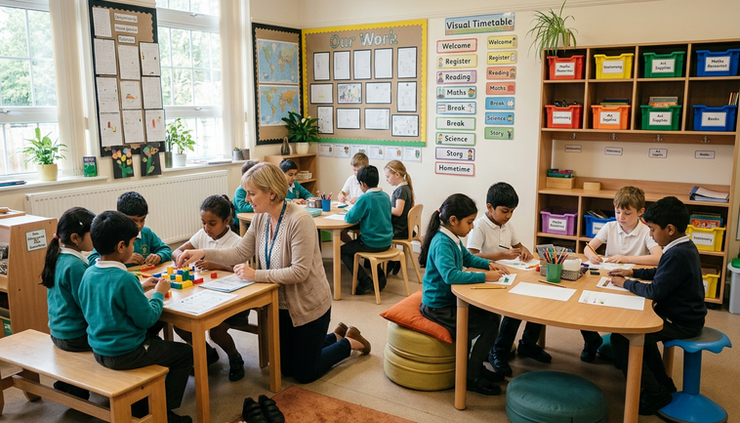
Display the lesson sequence with simple words or symbols
Show an example of a finished task
Explain how long an activity will last
Teach social routines, such as joining a game or disagreeing politely
Use clear instructions, one step at a time
Check understanding without putting the student on the spot
Instead of saying, “Get ready for literacy,” say, “Open your book, write today’s date, and read the first question. You have three minutes.” Specific language reduces stress.
Build in sensory awareness
Classrooms can be intense sensory spaces. Chairs scrape, lights flicker, classmates move, displays crowd the walls, and smells drift in from lunch. For some students, sensory input is not a minor distraction. It can feel painful or overwhelming.
Simple adjustments can help:
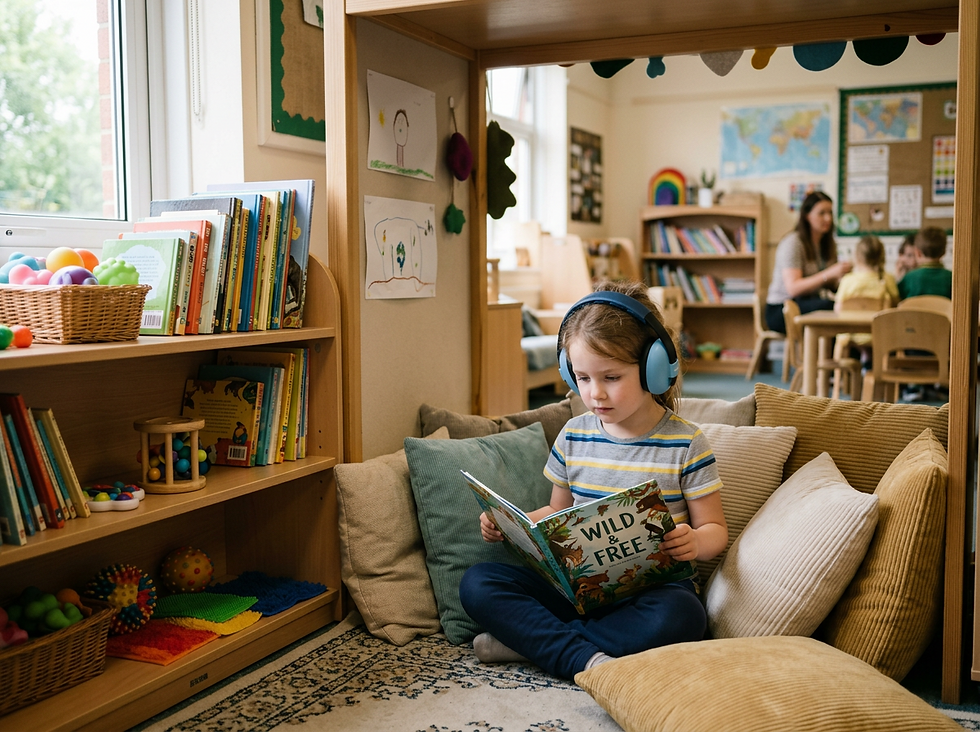
Offer a quieter area for short regulation breaks
Allow ear defenders or noise-reducing headphones where appropriate
Keep some wall space clear to reduce visual overload
Seat students away from busy doorways if movement is distracting
Use natural light when possible
Warn the class before loud noises, alarms, or room changes
Provide movement jobs, such as handing out books or carrying a message
A sensory break should not be treated as a reward. It is often a tool that helps a student return to learning.
Reduce shame around difference
Students notice who leaves the room, who uses a laptop, who gets extra time, and who has a different worksheet. A classroom culture that normalises support can protect dignity.
Useful language includes:
“Different people use different tools to learn.”
“Fair does not always mean the same.”
“We practise asking for what we need.”
“Everyone has strengths and things they are working on.”
This helps the whole class understand that support is not special treatment. It is part of learning.
Teaching methods should offer more than one route to success
A single method of instruction can create unnecessary barriers. When teachers vary how students receive information, practise skills, and show learning, more pupils can take part.
Give instructions in more than one format
Many neurodivergent students struggle when instructions are only spoken. Working memory can become overloaded, especially during multi-step tasks.
Try combining:
Spoken explanation
Written steps on the board
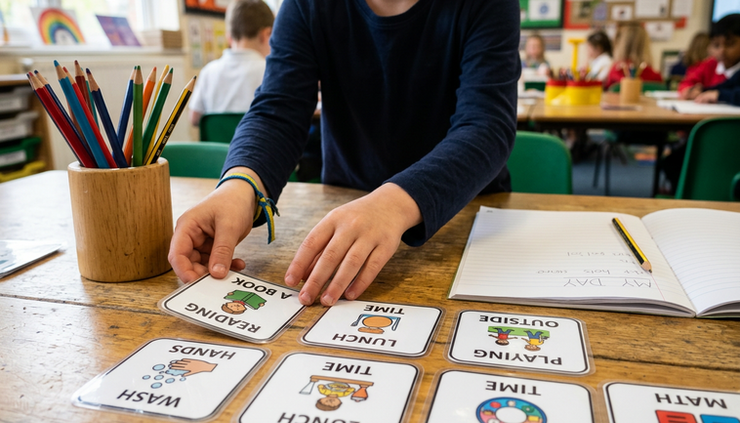
Visual icons or task cards
A modelled example
A quick check-in with selected pupils
Chunking helps. Give two steps, let students begin, then add the next step. This works better than giving a long list and expecting every student to hold it in mind.
Support executive function directly
Executive function includes planning, starting, organising, shifting attention, and monitoring progress. Students are not born knowing how to manage these skills under pressure. Some need them taught very clearly.
Practical supports include:
Barrier | Classroom support |
Getting started feels overwhelming | Provide a “first step” card or start the first question together |
Losing track during a task | Use a checklist with tick boxes |
Time feels abstract | Use a visual timer or countdown warnings |
Books and equipment go missing | Use colour-coded folders and a consistent storage place |
Big projects create panic | Break the project into smaller deadlines |
These supports are not shortcuts. They teach the structure that some students cannot yet create on their own.
Offer choices in how students show understanding
A student’s written output does not always reflect what they know. This is especially true for learners with dyslexia, DCD, ADHD, or language processing differences.
Depending on the learning goal, students might show understanding by:
Giving an oral explanation
Drawing a labelled diagram
Using speech-to-text
Recording a short audio response
Building a model
Completing a cloze passage
Working with sentence starters
Choosing between typed and handwritten work
If the goal is to assess sentence punctuation, writing matters. If the goal is to assess knowledge of volcanoes, a labelled diagram or oral explanation may be a fairer route.
Use interests without letting them take over
Special interests can be powerful learning bridges. A student fascinated by trains might explore timetables in maths, forces in science, or persuasive writing through a transport debate. A pupil who loves animals might engage more deeply with classification, habitats, or statistics.
The key is balance. Interests can open the door, then teachers can gently widen the path. This respects the learner while still broadening their curriculum experience.
Communication with parents and carers strengthens support
Families often hold vital knowledge. They may know early signs of overwhelm, useful calming strategies, sleep patterns, triggers, interests, or communication preferences. Teachers bring another view: how the student learns among peers, responds to curriculum demands, and manages the school day.
Good communication works best when it is regular, respectful, and specific.
Instead of contacting home only when something has gone wrong, share small wins:
“They used the checklist independently today.”
“They joined the group task for ten minutes.”
“Reading aloud was hard, so we tried paired reading and it helped.”
“They asked for a break before becoming distressed.”
These messages build trust. They also show that the child is seen as more than a problem to solve.
When discussing concerns, focus on patterns and supports. Say, “We have noticed transitions after lunch are difficult. At home, are there routines that help with changes?” This invites collaboration rather than blame.
For students with individual education plans, support plans, or involvement from specialist staff, parents should understand what is being tried and why. Plans should be practical enough to use during a busy school day. A long document that no one can remember will not help much. A short set of agreed strategies, reviewed often, is more likely to make a difference.
Students should also have a voice where possible. Even young children can often say whether a seat, tool, or routine helps. Older students may know exactly what makes learning easier, but they may need reassurance that asking for support is acceptable.
Case studies show how small changes can shift learning
The following examples are anonymised and illustrative, but they reflect common classroom patterns.
A writing barrier was mistaken for low effort
A Year 5 pupil often avoided extended writing. They sharpened pencils, asked to go to the toilet, and produced only a few lines. The first assumption was that they lacked ideas.
A closer look showed a different picture. In discussion, the pupil used rich vocabulary and understood the topic well. Handwriting was slow and tiring, and spelling demands interrupted every sentence.
The teacher changed the task structure. The pupil planned ideas orally with a partner, used a word bank, and drafted on a laptop for longer pieces. For shorter tasks, they used sentence starters and focused on one writing target at a time.
The change was clear. The pupil wrote more, avoided less, and began sharing ideas with confidence. Expectations stayed high, but the route became fairer.
A sensory plan reduced afternoon distress
A Key Stage 1 child became tearful and disruptive most afternoons. The behaviour often followed lunch, corridor noise, and a busy carpet session. Sanctions did not help. They made the child more anxious.
The class team tracked when distress happened and what came before it. They introduced a predictable after-lunch routine: a quiet entry task, a visual schedule, a seat near the edge of the carpet, and access to a calm corner for two minutes when needed.
The child still had difficult days, but the pattern changed. They returned to learning faster and needed fewer adult interventions. The teacher also noticed that other pupils enjoyed the calmer start to the afternoon.
A parent partnership improved school attendance
A secondary student with ADHD and anxiety often arrived late or missed school after unfinished homework led to panic. Home and school were stuck in a cycle of reminders, frustration, and avoidance.
The form tutor, parent, and student agreed on a simpler system. Homework tasks went into one online list. Teachers marked the most important task when workload built up. The student used a weekly check-in to plan when to do each task. Home focused on the plan rather than repeated prompts.
Attendance improved over time because mornings became less loaded with conflict. The student also began to recognise which tasks needed help earlier, rather than waiting until panic set in.
Inclusive practice grows through reflection, not perfection
No teacher gets every support right the first time. Needs change by subject, age, stress level, friendship issues, sleep, and the demands of the lesson. A strategy that works in September may need adjusting by January.
The most useful cycle is simple:
Notice the barrier
Ask what skill or need may sit underneath it
Try one clear support
Watch what changes
Adjust with the student and family
This approach keeps the focus on learning, dignity, and progress. It also prevents the classroom from becoming a long list of separate accommodations. Many supports can become normal practice for everyone.
A few broad habits make the biggest difference:
Assume competence A student may need another way in, not a lower ceiling.
Teach routines explicitly Clear routines reduce anxiety and free up attention for learning.
Regulate before reasoning A distressed student cannot always process advice or consequences in the moment.
Use strengths as starting points Confidence grows when students feel known for what they can do.
Keep communication human Families are more likely to share useful information when they feel respected.

Inclusive teaching is not a separate project added to an already full timetable. It is a way of designing lessons, routines, and relationships so fewer students have to struggle silently. When teachers understand neurodiversity, make expectations clear, adapt routes into learning, and work closely with families, classrooms become calmer and more ambitious for everyone.
The next step can be small: choose one student, identify one barrier, and test one support this week. Small changes, repeated with care, can reshape a learner’s experience of school.